 how-to
How to Prioritize Electrical Panel Upgrades
Table of Contents
- Why Prioritizing Electrical Panel Upgrades Matters
- Signs You Need an Electrical Panel Upgrade
- Electrical Panel Capacity and Load Calculation
- A Decision Framework for Panel Upgrade Prioritization
- Alternatives to a Full Panel Upgrade
- Electrical Panel Upgrade Cost Considerations
- Electrical Panel Upgrade Timeline and Project Planning
- Next Steps: Getting Professional Guidance
- Frequently Asked Questions
Last Updated: October 19, 2026
Why Prioritizing Electrical Panel Upgrades Matters
An electrical panel distributes electricity to every room and device. When it can't handle your home's demands, flickering lights, tripping breakers, and safety hazards become routine. The question isn't whether you need to upgrade, it's when and how to prioritize electrical panel upgrades to match your needs and budget.
Most homeowners face the same dilemma: an outdated panel creates real risk, but a full replacement costs thousands. The solution is a prioritization framework that separates urgent safety issues from capacity needs from future-proofing.
This guide walks you through the same process.
Signs You Need an Electrical Panel Upgrade
Immediate Safety Concerns
Some panel problems demand urgent attention. These aren't inconveniences, they're fire and shock hazards.
Burning smells near the panel mean wiring or connections are overheating.
Visible corrosion, rust, or water damage inside or around the panel indicates the enclosure is compromised.
Frequent breaker tripping even with few appliances running suggests the panel is undersized for your home's load. Repeated tripping stresses breaker components and increases fire risk.
Buzzing or crackling sounds from the panel mean arcing is occurring inside, electricity jumping between connections where it shouldn't.
A panel that's hot to the touch indicates excessive current flow or internal resistance. Never ignore this.
These signs mean you need a licensed electrician to inspect immediately. Don't delay hoping the problem resolves itself.
Capacity and Performance Issues
Capacity problems develop more gradually but still need attention.
Lights dimming when major appliances start means your service capacity can't handle simultaneous loads, routing too much current through aging wiring.
An old panel with few available breaker slots limits adding circuits for new appliances, EV chargers, or smart home systems. At 80% capacity, installing a heat pump or vehicle charger isn't possible.
Frequent calls to reset a tripped breaker in the same circuit suggests that circuit is overloaded for its intended use.
Inability to support modern appliances: your panel may work for older, lower-power devices but can't handle electric ranges, heat pumps, and EV chargers, which need substantial amperage.
These problems don't create immediate danger but prevent you from using your home as you want. They belong in Tier 2 of your prioritization.
Electrical Panel Capacity and Load Calculation
Understanding Your Current Amperage
Your service capacity is measured in amps. Most homes built before 1990 have 100-amp service. Homes built 1990-2000 typically have 150-amp service. Newer construction often has 200-amp service.
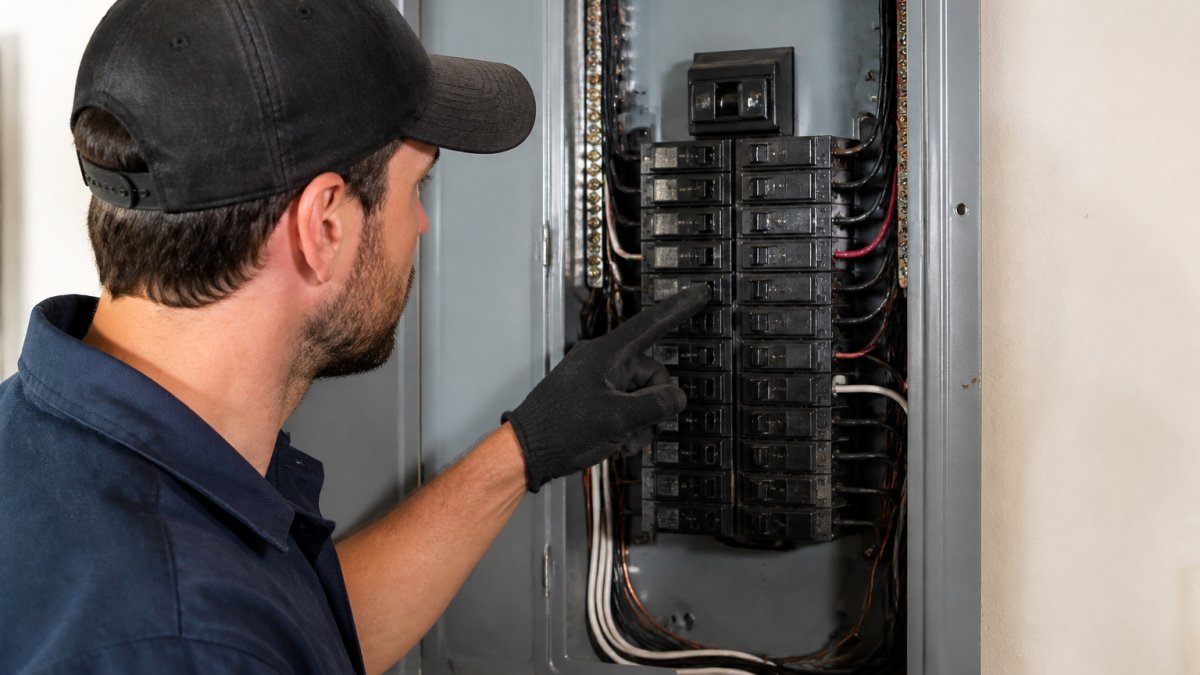
Find your panel's amperage rating on the main breaker at the top of the panel: 40, 60, 100, 150, or 200 amps. That's your service capacity.
Older 40-amp or 60-amp panels are almost always too small for modern homes.
Your actual available capacity is lower than the panel rating. The National Electrical Code (NEC) limits your usable load to 80% of the panel's rating.
Calculating Your Electrical Load
Load calculation tells you how many amps your home actually uses at peak demand.
Start by listing major appliances and their typical amperage:
- Electric water heater: 20-30 amps
- Electric range or oven: 40-50 amps
- Air conditioning: 15-40 amps (depends on tonnage)
- Heat pump: 15-30 amps
- EV charger (Level 2): 30-50 amps
- Refrigerator: 5-10 amps
- Dishwasher: 10-15 amps
- Washing machine: 10-15 amps
- Microwave: 10-15 amps
- Lighting and outlets (per circuit): 15-20 amps
You don't add every appliance's amperage together because they don't all run simultaneously. The NEC uses demand factors to calculate realistic peak load.
For a typical 2,000-square-foot home:
- Heating and cooling: 30-40 amps
- Water heater: 20-25 amps
- Kitchen appliances: 25-35 amps
- Laundry: 10-15 amps
- Lighting and general outlets: 20-30 amps
- Estimated peak load: 105-145 amps
If you're adding an EV charger (30-50 amps) or heat pump (15-30 amps), your peak load climbs to 140-195 amps. A 100-amp panel won't support this. A 150-amp or 200-amp panel becomes necessary.
This is where many homeowners realize they need to prioritize electrical panel upgrades sooner than expected.
A Decision Framework for Panel Upgrade Prioritization
Tier 1: Urgent Safety Issues
Act within 1-2 weeks. These problems create immediate risk.
- Burning smells or visible damage
- Water intrusion or corrosion
- Frequent arcing or crackling sounds
- Panel temperature abnormally high
- Exposed wiring or loose connections inside the panel
Action: Schedule a licensed electrician for inspection. Many Tier 1 issues don't require full replacement; a repair or partial upgrade may solve the problem, but you need professional diagnosis first.
Cost driver: Repair or targeted upgrade, not necessarily full replacement.
Tier 2: Near-Term Capacity Needs
Plan within 3-6 months. These limit your home's function but aren't immediate hazards.
- Adding an EV charger
- Installing a heat pump for heating and cooling
- Upgrading to an electric range
- Frequent breaker tripping on specific circuits
- Lights dimming when major appliances run
- Panel at 80% capacity with no available breaker slots
Action: Get a professional load calculation and capacity assessment. Determine whether a service upgrade is needed or whether load management and circuit redistribution solve the problem.
Cost driver: Full panel replacement if service upgrade is necessary; targeted circuit upgrades if capacity is adequate.
Tier 3: Future-Proofing and Planned Upgrades
Plan within 1-2 years. These improve your home's flexibility and resale value but aren't urgent.
- Aging panel (30+ years old) still functioning normally
- Planning a major renovation that will add circuits
- Wanting to future-proof for potential EV charger or solar installation
- Upgrading from 100-amp to 150-amp or 200-amp service for peace of mind
- Installing smart home automation that requires additional circuits
Action: Plan the upgrade as part of your renovation or seasonal maintenance schedule. Tier 3 upgrades can often be bundled with other electrical work to reduce total project cost.
Cost driver: Full panel replacement as a planned upgrade, not emergency.
Alternatives to a Full Panel Upgrade
Load Management and Smart Panels
Not every capacity problem requires a full panel replacement. Sometimes smarter load management solves the problem.
Circuit redistribution moves high-demand loads to separate circuits or combines low-demand ones. A licensed electrician can rebalance your panel to reduce strain on overloaded circuits, making better use of existing capacity.
Smart panels and load prioritization systems manage when appliances run to prevent simultaneous peak demand.
Demand-side management helps too: running the dishwasher and laundry at different times than your air conditioning reduces simultaneous demand, free, and often works for moderate load problems.
When this works: Your panel has adequate service capacity but specific circuits are overloaded, peak load is near but not exceeding capacity, and you're willing to manage appliance usage strategically.
Phased Upgrades and Project Sequencing
Full panel replacement is expensive. Phased upgrades spread cost and disruption over time.
Phase 1: Repair or stabilize the existing panel. Address immediate safety concerns. Redistribute circuits to optimize current capacity.
Phase 2 (3-6 months later): Install a sub-panel for specific high-demand loads.
Phase 3 (1-2 years later): Upgrade the main service when budget allows or when the sub-panel approach reaches its limits.
When this works: You need capacity for one or two specific new appliances but your overall service is adequate. You want to defer major expense. Your existing panel is safe but undersized.
When it fails: Your panel has safety issues that require immediate replacement. Adding sub-panels complicates the system and costs nearly as much as a full upgrade.
Electrical Panel Upgrade Cost Considerations
Cost Drivers and Budget Planning
Panel replacement cost depends on several factors. Understanding them helps you budget realistically.
Service upgrade complexity: Upgrading from 100 to 150 amps is simpler than to 200 amps.
Existing infrastructure: If your home already has adequate wire and conduit run to the meter, cost is lower.
Utility requirements: Your utility may require upgrades to the service entrance, meter base, or utility lines.
Permit and inspection costs: Electrical permits and inspections are required for panel work.
Panel type and options: A standard 200-amp panel costs less than a smart panel with load management features.
Timing and seasonality: Emergency calls cost more than planned upgrades. Off-peak scheduling sometimes reduces cost.
Labor complexity: Homes with difficult meter access, underground service, or unusual configurations cost more to upgrade.
Electrical Panel Upgrade Timeline and Project Planning
Permits, Inspections, and NEC Compliance
Electrical panel work requires permits and inspections in virtually all jurisdictions. This isn't optional, it protects your safety and your home's insurability.
Permit process: Contact your local building department or electrical inspector with details about your existing panel and proposed upgrade. They'll tell you what permits are required and what the process costs.
NEC compliance: All electrical work must meet the National Electrical Code. Unlicensed work that violates NEC standards creates liability and may void insurance coverage.
Inspection timeline: After the work is complete, the inspector schedules an inspection. Most jurisdictions complete inspections within 1-2 weeks.
Documentation: Keep all permits, inspection reports, and receipts. These documents prove the work was done correctly and are important for insurance claims or future home sales.
Scheduling and Coordination
Panel replacement disrupts your electrical service. Plan the timing carefully.
Service outage duration: The utility typically cuts power for 1-4 hours during the meter and main service connection. You'll have no electricity during this window.
Pre-work preparation: Before the electrician arrives, clear access to your panel. Remove items stored in front of or around it. Ensure the electrician has safe working space.
Coordination with other trades: If you're doing a renovation, coordinate the panel upgrade with other electrical work. Doing everything at once reduces total project time and cost.
Post-upgrade testing: After inspection approval, the electrician tests all circuits and verifies proper operation. This usually takes 1-2 hours.
Total project timeline: From permit application to final inspection typically takes 2-4 weeks. Emergency or complex upgrades may take longer.
Next Steps: Getting Professional Guidance
Your electrical panel is too important to guess about. A licensed electrician provides the clarity you need.
Understand your options. Not every capacity problem requires full panel replacement. Load management, circuit redistribution, or sub-panels sometimes solve the problem at lower cost.
Plan your timeline. Urgent safety issues need immediate action. Capacity needs can be planned over months. Future-proofing fits into your renovation schedule. A clear timeline removes the stress of guessing when to act.
Get multiple perspectives. Talk to two or three licensed electricians and compare assessments; different professionals may propose different solutions based on their experience and your situation.
T6 Electrical Contractor helps homeowners and commercial property managers work through these decisions.
Frequently Asked Questions
What is the 80% rule for electrical panels?
The 80% rule, defined in the National Electrical Code (NEC), means your continuous electrical load should not exceed 80% of your panel's total amperage capacity. For example, a 200-amp panel should handle no more than 160 amps of continuous load. This safety margin prevents overheating and reduces fire risk. Exceeding this threshold signals you need to prioritize an electrical panel upgrade to maintain code compliance and home safety.
How do I know whether my electrical panel has enough capacity?
Check your panel's amperage rating (typically 100, 150, or 200 amps) on the main breaker. Calculate your home's electrical load by adding the wattage of all major appliances, heating systems, and devices you run simultaneously. Divide total watts by 240 volts to get amps needed. If your load exceeds 80% of your panel's capacity, or if you plan to add an EV charger or heat pump, your panel likely needs an upgrade. A licensed electrician can perform a detailed load calculation to confirm.
Should I upgrade my electrical panel before installing an EV charger or heat pump?
Most EV chargers require 30-50 amps, and heat pumps demand 20-40 amps. If your current panel is already at or near 80% capacity, adding either appliance will exceed safe limits and trigger a panel upgrade. Prioritize the upgrade first to avoid code violations and safety hazards. Planning both projects together often reduces overall costs and scheduling complexity compared to upgrading later.
What's the average cost to upgrade your electrical panel?
Electrical panel upgrade costs depend on amperage increase, local labor rates, permit fees, and whether rewiring is needed. Contact T6 Electrical Contractor for a personalized quote based on your specific situation, home age, and local requirements.
Ready to understand your panel's true status? Contact T6 Electrical Contractor for a professional electrical assessment. We'll evaluate your current service capacity, identify safety concerns, calculate your actual load, and recommend the right upgrade path for your home and budget. Get started with a consultation that saves you time, money, and worry.