 how-to
7 Reasons Your Breaker Keeps Tripping and How to Fix Each
Last Updated: November 7, 2026
Quick Summary
A breaker keeps tripping because it senses too much current or a fault in the circuit and cuts power to protect your wiring from overheating and fire. Common causes include circuit overload, short circuits, ground faults, faulty appliances, loose wiring, and a failing breaker. A repeated trip is a warning, so track when it happens and stop resetting it if it trips right away.
- Track when the breaker trips, what was running, and which breaker it is.
- Never keep resetting a breaker that trips right away.
- Unplug everything on the circuit, reset it, then add loads one at a time.
- A burning smell, smoke, sparks, or hot outlets mean shut off power and call an electrician.
- Do not replace a tripping breaker with a higher-amperage one.
Table of Contents
- Why a Breaker Keeps Tripping: What the Breaker Is Protecting You From
- Step 1: Note When the Breaker Trips and What Was Running
- Why Does My Breaker Keep Tripping After Reset?
- Why Does My Breaker Keep Tripping With Nothing Plugged In?
- Why Does My Breaker Keep Tripping When I Use My Microwave?
- Is It Dangerous If a Circuit Breaker Keeps Tripping?
- Booking a Diagnostic Visit With T6 Electrical Contractor in DFW
- Frequently Asked Questions
Why a Breaker Keeps Tripping: What the Breaker Is Protecting You From
Why does my breaker keep tripping? A circuit breaker trips when it senses too much current or a fault in the circuit, and it cuts power to protect your wiring and your home from fire.
Breakers are designed to shut off before wires overheat. When current rises above the breaker's rating, the breaker opens the circuit. That is a safety feature doing its job.
Here are the most common causes, and we will work through each one:
- Circuit overload: Too many devices drawing power on one circuit
- Short circuit: Hot and neutral wires touching directly
- Ground fault: Current leaking to ground, often through water or damaged insulation
- Faulty appliance: A device with an internal short or failing motor
- Loose or damaged wiring: Connections that heat up or arc
- Failing breaker: A worn breaker that trips without a real fault
- Outdated or overheated panel: Corrosion or wear inside the panel
Once you know what the breaker is protecting against, the next step is to gather clues. The sections below show you how.
Step 1: Note When the Breaker Trips and What Was Running
The fastest way to find the cause is to track the pattern. Write down these details each time the breaker trips:
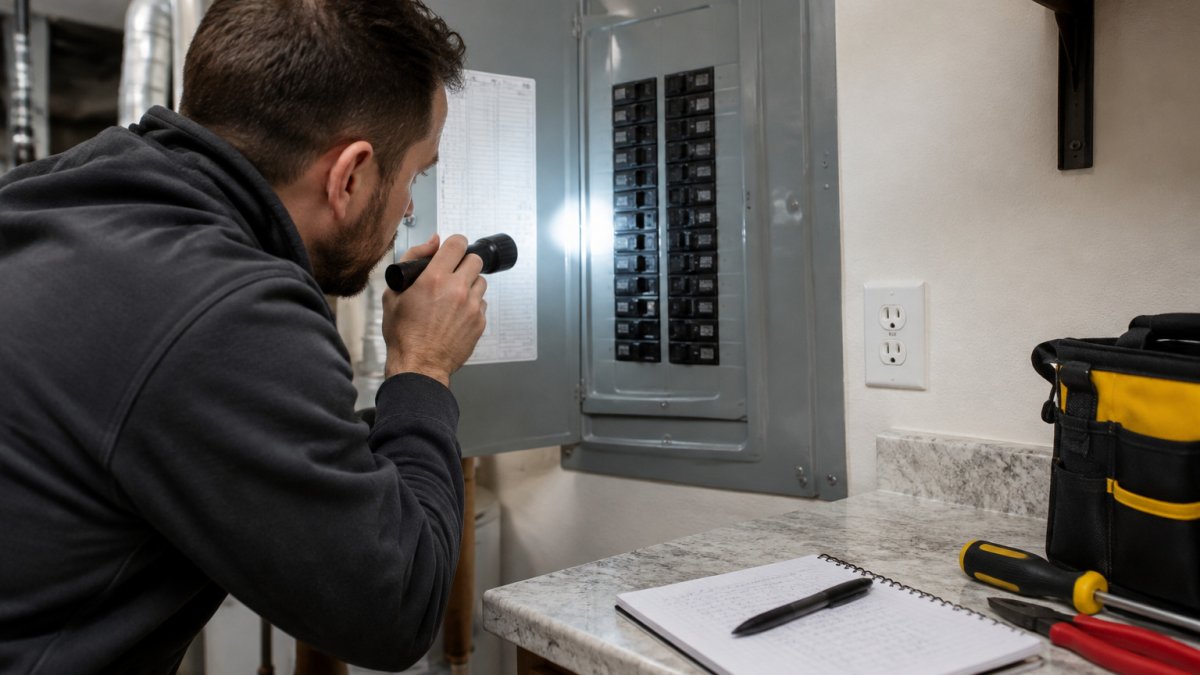
- Time of day: Does it trip in the morning, evening, or during a certain activity?
- What was running: Which appliances, lights, or tools were on?
- Which breaker: Label the breaker number and the rooms it feeds.
- Conditions: Was it humid, raining, or cold? Did you notice a burning smell?
Patterns often point straight to the cause. A breaker that trips only when the space heater runs suggests an overload.
Watch out: never keep resetting a breaker that trips right away while you ignore the smell of burning plastic or hot outlets.
Tracking the pattern of each trip makes the cause easier to find. The table below lists what to record and what each pattern usually suggests.
| Clue | What it may point to | Next step |
|---|---|---|
| Trips when space heater runs | Circuit overload | Move heater to another circuit |
| Trips in wet or rainy weather | Ground fault, often outdoors | Check outdoor outlets and fixtures |
| Trips right after reset | Fault is still present | Stop resetting and call an electrician |
| Burning smell at outlet or panel | Overheating connection | Shut off power and call a licensed electrician |
Why Does My Breaker Keep Tripping After Reset?
Why does my breaker keep tripping after reset? A breaker that trips again right after a reset usually means the fault is still present.
Here is a safe way to troubleshoot:
- Turn off everything on the circuit. Unplug appliances and switch off lights.
- Reset the breaker. Push the switch fully to OFF, then back to ON.
- Add loads one at a time. Plug in one device at a time and watch for a trip.
- Note the device that causes the trip. That item is your likely culprit.
If the breaker holds with nothing connected but trips when a device is added, that device may have an internal fault.
Many homeowners find that a breaker which trips after every reset has a serious fault. In that case, stop resetting it and call an electrician.
Why Does My Breaker Keep Tripping With Nothing Plugged In?
Why does my breaker keep tripping with nothing plugged in?
A breaker that trips with no load connected is telling you one of four things:
- A wiring fault is present. Damaged insulation, a nicked conductor, or a wire pinched against a metal box can create a short circuit or a ground fault that exists whether or not an appliance is plugged in. The breaker opens because current is escaping the intended path, not because demand is high.
- A fixture or device on the circuit is still connected. Switched fixtures, hardwired appliances, doorbell transformers, smoke detectors, and outdoor lighting are all part of the circuit even when nothing is plugged into a receptacle. A fault inside one of them will trip the breaker with the outlets empty.
- Moisture has entered the circuit. Water in an outdoor receptacle, a landscape lighting connection, or a junction box creates a leakage path to ground. This pattern often shows up after rain or in humid weather and is a common reason a breaker trips overnight or first thing in the morning.
- The breaker itself has failed. Breakers wear out. A breaker that trips at currents well below its rating, feels warm at the handle, or trips without any load may be at the end of its service life. A failing breaker is a replacement item, not a repair item.
Breaker type matters here, and this is where most guides stop short. A standard breaker responds to overcurrent and short circuits.
A safe way to narrow it down without opening anything:
- Confirm what is actually on the circuit. Flip the breaker off and check every receptacle, light, and hardwired device the label mentions. Map the circuit before you assume it is empty.
- Reset once with the circuit confirmed empty. Push the handle fully to OFF, then to ON. If it holds, the fault is intermittent and likely load- or moisture-related.
- If it trips again immediately, stop. Do not reset it a third time. A breaker that will not hold with an empty circuit is reporting a fault that resetting cannot fix.
- Leave the breaker off and label it. Tape the handle in the OFF position so no one restores power to a circuit under suspicion.
Watch out: never open a panel cover, remove a receptacle, or probe wiring to trace a fault yourself.
A licensed electrician can diagnose this kind of problem, and a qualified electrician will know which tests and inspections the circuit needs.
Why Does My Breaker Keep Tripping When I Use My Microwave?
Why does my breaker keep tripping when I use my microwave? Microwaves draw a lot of current, often 10 to 15 amps or more. If the microwave shares a circuit with other heavy loads, the total can exceed the breaker's rating.
Check these possibilities:
- Overloaded circuit: The microwave shares a circuit with a toaster, coffee maker, or space heater
- Microwave on a general-purpose circuit: Many kitchens use one circuit for several outlets
- Faulty microwave: A failing magnetron or internal short can draw excess current
- Loose outlet connection: A worn outlet heats up under a high load
Solutions to try:
- Run the microwave alone and see if the trip still happens
- Move other kitchen appliances to a different outlet or circuit
- Have an electrician check whether the microwave needs a dedicated circuit
Many kitchens built decades ago were never designed for today's appliance loads. If the microwave trips the breaker regularly, the circuit may need an upgrade.
Is It Dangerous If a Circuit Breaker Keeps Tripping?
Yes, a breaker that keeps tripping can be dangerous, and the level of danger depends on why it is tripping and what you do next. To check your panel for signs of a serious problem, see warning signs to check.
Treat the situation as urgent, not routine, when you see any of these:
- A burning or acrid smell near an outlet, switch, appliance, or the panel. This is the strongest signal of overheating insulation or a failing connection.
- Smoke or sparks at an outlet, fixture, or panel. Leave the area and call 911 if there is active smoke or fire.
- Scorched, discolored, or melted outlet covers and switch plates. Heat marks mean the connection has already been running hot.
- A buzzing, humming, or crackling panel or breaker. Buzzing at the panel can indicate a loose connection or a failing breaker and is not normal.
- Outlets, switches, or the panel face that feel warm or hot to the touch. Warmth at a device under load is a warning, not a quirk.
- A breaker that will not reset, or that trips again immediately after reset. This means the fault is still present and the breaker is refusing to energize a compromised circuit.
- Lights that flicker, dim, or brighten when appliances cycle. This can point to a loose neutral or a service-level problem, not just a branch circuit issue.
What to do, in order:
- Stop using the circuit. Unplug devices on it and turn off its switches. Do not keep resetting the breaker to 'see if it holds.'
- Turn the breaker fully to OFF and leave it there. Tape the handle if others in the home might reset it.
- If there is a burning smell, smoke, sparks, or a hot panel, leave the home and call 911. Do not open the panel to investigate.
- If there is no active smoke or fire but the warning signs are present, call a licensed electrician for an emergency or same-day visit. Describe the smell, the heat, and the trip pattern so the electrician can prioritize the call.
- Do not cover the symptom with a larger breaker. Replacing a tripping breaker with a higher-amperage one removes the protection the circuit was designed around and is a code violation as well as a fire risk.
A repeated trip with no warning signs is still worth a professional look, but it is not an emergency. To judge whether your situation is a true electrical emergency, see whether your situation is an emergency.
Booking a Diagnostic Visit With T6 Electrical Contractor in DFW
If your breaker keeps tripping and the troubleshooting above has not solved it, a professional diagnosis is the safest next step. At T6 Electrical Contractor, we work to find the actual cause of the problem. To see how to book an electrical repair visit, follow the steps on that page.
Pricing depends on the scope of work. Visit the T6 Electrical Contractor website to request a quote and current pricing details.
Frequently Asked Questions
How do you fix a breaker that keeps tripping?
Start by unplugging or switching off everything on the affected circuit, then reset the breaker at the panel by moving it fully to OFF and then ON. If it holds, plug devices back in one at a time and watch for the trip. If it trips right away with everything off, the fault is in the wiring or the breaker itself, and that calls for a licensed electrician. Do not replace a breaker with a higher amp rating to stop trips, because that removes the protection the wire depends on and raises fire risk.
Is it dangerous if a circuit breaker keeps tripping?
Repeated tripping is a warning sign, not a nuisance. The breaker is doing its job by cutting power when current exceeds safe levels or when it detects a short or ground fault. Frequent trips can point to overheated wiring, loose connections or damaged insulation, all of which can lead to arcing and fire if ignored. Stop using the affected circuit if you notice a burning smell, scorched outlets, warm panel covers, buzzing or flickering, and call an electrician promptly.
Why does my breaker trip when I plug something in?
A breaker that trips as soon as you plug in an appliance usually indicates a short circuit or a ground fault in that device, its cord or its outlet. Unplug the device and try another outlet on a different circuit. If the breaker holds, the appliance or cord is the likely cause. If the trip happens with the device unplugged, the problem is in the house wiring and needs professional diagnosis.
How many times can a breaker trip before it breaks?
There is no fixed number, because breakers are rated to trip many times under normal protection duty, but repeated trips from a fault stress the internal mechanism and can wear out contacts over time. A breaker that feels loose in the panel, runs warm or no longer holds its position should be replaced by a licensed electrician. Frequent tripping should prompt an investigation of the cause rather than repeated resets.