 how-to
Is My Electrical Panel Safe? Warning Signs to Check
Last Updated: November 1, 2026
Quick Summary
You can spot many warning signs of an unsafe electrical panel yourself, including rust, burning smells, scorch marks, and frequently tripping breakers. Only a licensed electrician can confirm whether your electrical panel safe.
- Check for rust, water stains, or corrosion around the cabinet.
- Treat any burning smell or scorch marks as urgent and call an electrician.
- A breaker that keeps tripping signals a fault that needs professional repair.
- Never open the panel cover; that work belongs to a licensed electrician.
- Keep at least 3 feet of clear working space in front of the panel.
Table of Contents
- Why Electrical Panel Safety Matters for Your Home
- Electrical Panel Warning Signs You Can Spot Yourself
- When a Circuit Breaker Keeps Tripping
- Electrical Panel Safety Checklist for Homeowners
- What a Professional Electrical Panel Inspection Includes
- Urgent Actions if You Spot Danger Signs
- Booking Your Panel Inspection with T6 Electrical Contractor
- Frequently Asked Questions
Why Electrical Panel Safety Matters for Your Home
An electrical panel is the heart of your home's power system, and a panel that is failing can put your family and property at real risk.
Electrical panel safety is worth checking because problems often build slowly.
This guide walks you through the most common warning signs, a simple homeowner checklist, and the steps to take if something looks wrong.
- Panel problems often develop slowly and quietly
- Many warning signs are visible from outside the panel
- Only a licensed electrician should open or repair the panel
Electrical Panel Warning Signs You Can Spot Yourself
Warning signs are easiest to catch when you look at the panel from a safe distance. Start with the outside of the cabinet and the area around it, and do not remove the cover.
A panel that is overdue for attention often shows one or more of these signs:
- Rust, corrosion, or water stains on or around the cabinet
- A burning smell, discoloration, or scorch marks near the panel
- Breakers that trip often or feel hot to the touch
If you notice any of these, the panel deserves a professional look soon.
Rust, Corrosion, and Water Damage
Moisture is one of the biggest enemies of an electrical panel. Rust on the cabinet, green or white crust on metal parts, or water stains on the wall behind the panel all point to a moisture problem.
Check the area around the panel for leaks, pipes, or a damp floor. A wet panel is a serious hazard, so report standing water or dripping to an electrician right away.
Burning Smells, Scorch Marks, and Overheating
A burning smell near the panel is a red flag and should never be ignored. Plastic or insulation overheating can give off a sharp, acrid odor.
If you smell burning or see scorching, turn off the main breaker only if you can do so safely and without touching the panel interior. Then call an electrician immediately. If there is smoke or fire, leave the home and call 911.
When a Circuit Breaker Keeps Tripping
A breaker that trips once in a while is normal. A breaker that trips often is telling you something is wrong.
Frequent tripping is a warning sign because the breaker is doing its job by cutting power before wiring overheats.
Watch for these patterns:
- The same breaker trips again soon after being reset
- A breaker feels warm or hot when you touch the switch
- Lights dim or flicker when an appliance turns on
If a breaker keeps tripping, unplug the devices on that circuit and call an electrician. Repeated tripping can signal a fault that needs a repair, not just a reset.
Electrical Panel Safety Checklist for Homeowners
This checklist is built around one rule: you can look, listen, and smell from outside the panel, but you do not open the cover, remove deadfronts, or touch wiring. Anything past that line is electrician work. The checklist below separates the two so you know exactly where your role ends.
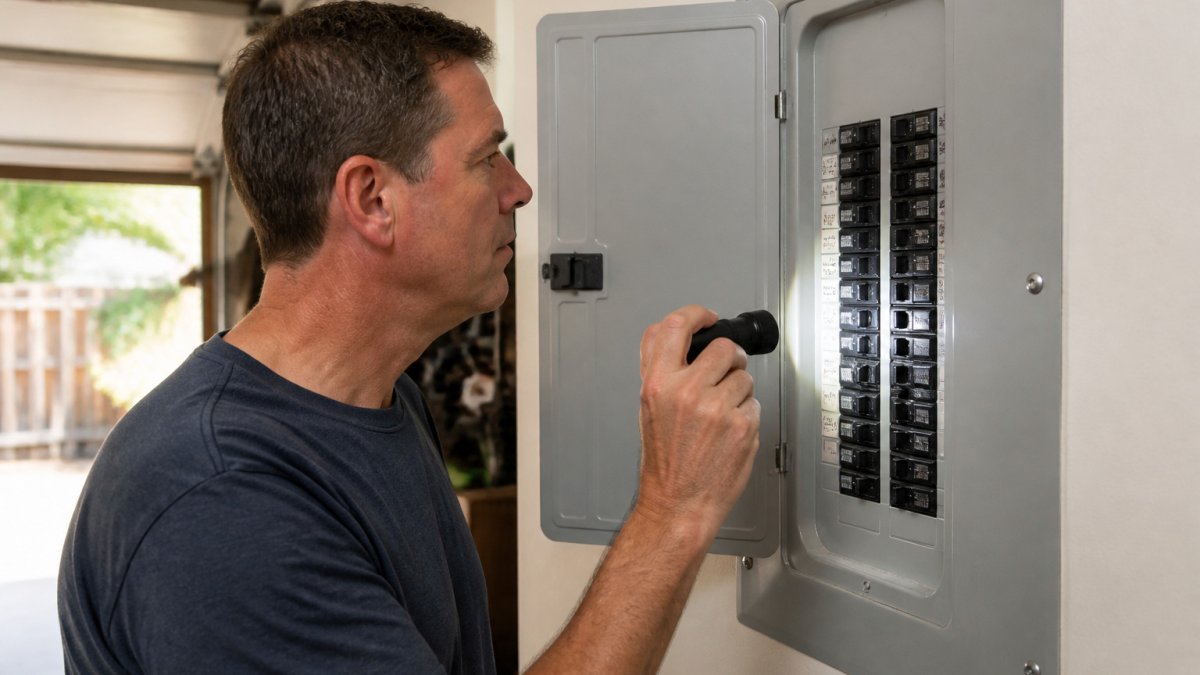
Safe visual and sensory checks (no tools, no cover removal)
Work through these from a normal standing distance. If any item fails, stop and schedule an inspection rather than probing further.
- Cabinet condition: The cover is fully attached, uncracked, and not visibly warped. A loose or missing cover exposes live bus bars.
- Moisture signs: No rust, green or white crust on metal, water stains on the wall behind the panel, or dampness on the floor beneath it. Corrosion raises resistance at connections, which is a heat source.
- Heat signs: No brown discoloration, melted plastic, or scorch marks on the cover or surrounding drywall. Discoloration on the cover usually means heat is escaping from inside.
Electrician-only checks (do not attempt)
These require opening the panel or using test equipment, and they carry arc-flash and shock risk that a homeowner cannot manage without training and protective gear:
- Removing the cover or deadfront to inspect bus bars, lugs, and breaker connections
- Torque-checking terminal screws (manufacturers publish torque values; loose lugs are a leading cause of panel fires)
- Testing breakers to confirm they trip within their rated curve
- Verifying grounding and bonding continuity with a meter
Recording your panel's identity for recall checks
Before you call anyone, capture three things from the label visible inside the door: the manufacturer name, the model or type designation, and the breaker brand printed on the breakers themselves. Then check the Consumer Product Safety Commission (CPSC) recall database at cpsc.gov for the manufacturer and model. Federal Pacific Electric (FPE) Stab-Lok and Zinsco panels are the two most commonly flagged obsolete types in older homes; both have documented failure-to-trip concerns, and many electricians recommend replacement rather than repair. If your panel matches a recalled or obsolete type, treat that as a finding to discuss with a licensed electrician, not a do-it-yourself repair.
CPSC recall database
If any box above is unchecked or you are unsure, the next step is a professional inspection, not a second look with the cover off.
The checklist below separates the safe visual and sensory checks a homeowner can do from the electrician-only work.
| Check | What to look for | Action if it fails |
|---|---|---|
| Cabinet condition | Cover attached, uncracked, not warped | Schedule inspection |
| Moisture signs | No rust, crust, water stains, or dampness | Schedule inspection |
| Heat signs | No discoloration, melted plastic, or scorch marks | Schedule inspection |
| Smell | No acrid, fishy, or burning-plastic odor | Schedule inspection |
| Sound | No buzzing, crackling, or humming under normal load | Schedule inspection |
| Breaker feel | Breakers reset firmly and are not hot to touch | Schedule inspection |
| Clearance | At least 3 feet clear working space in front | Clear the space |
What a Professional Electrical Panel Inspection Includes
A professional inspection is not one service; it is a scope you agree on before anyone opens the panel. Understanding the difference between a visual assessment and a full electrical evaluation lets you compare quotes fairly and know what you are paying for.
Visual assessment vs. full evaluation
A visual assessment is a walkthrough with the cover on. The electrician confirms clearance, looks for heat and moisture signs, reads the panel label, checks breaker labeling, and may use a non-contact voltage tester or thermal camera on the cover.
A full evaluation opens the panel and includes the tests below. It is the right scope when you have seen any warning sign, when the panel is more than 25 to 30 years old, when you are buying a home, or when you are adding a large load such as an EV charger or heat pump.
What a full evaluation typically includes
- Cover removal and interior inspection: Bus bars, lugs, breaker stabs, and wire terminations checked for corrosion, arcing marks, and discoloration.
- Torque verification: Terminal screws checked against the manufacturer's published torque values with a calibrated torque screwdriver. Loose lugs are a leading cause of panel fires.
- Breaker testing: Breakers exercised and, where the scope calls for it, tested to confirm they trip within their rated curve rather than merely switching on and off.
- Grounding and bonding continuity: The grounding electrode conductor, neutral-ground bond (present only at the service panel), and equipment grounding paths verified with a meter.
What the written findings should contain
Ask for findings in writing before you approve any work. A useful report names each issue, rates it (for example, immediate hazard, repair soon, monitor), and states the basis for the rating. It should also list the panel's rated capacity, the service size, and any code-relevant clearance or grounding deficiencies. If a contractor will not put findings in writing, that is a reason to get a second opinion.
How to verify the electrician is qualified
- Confirm the license through your state's electrical licensing board or the authority having jurisdiction (AHJ) that issues permits in your area.
- Ask for a certificate of insurance showing general liability and workers' compensation coverage.
- Confirm the contractor will pull a permit when the scope requires one; permitted work is inspected by the AHJ.
- Ask whether the person opening the panel is a licensed electrician or an apprentice working under direct supervision.
Pricing depends on panel capacity, service size, and the scope of work, so ask for a written estimate that itemizes the inspection, any repairs, permit fees, and replacement scope separately. Visit the T6 Electrical Contractor website for current pricing or a quote. That itemization is what lets you compare bids on equal terms.
Urgent Actions if You Spot Danger Signs
Some warning signs call for immediate action. If you see any of the following, act quickly:
- Smoke, sparks, or a strong burning smell
- Melted plastic, scorch marks, or a hot panel
- Water leaking onto or into the panel
- Buzzing or crackling sounds that are getting louder
Take these steps:
- Turn off the main breaker only if you can do it safely without touching the panel interior.
- If there is smoke or fire, leave the home and call 911.
- Keep people and pets away from the panel.
- Call a licensed electrician right away. Do not wait for a routine appointment.
Do not attempt repairs yourself. Once the danger is contained, learn how to prioritize an electrical panel upgrade. Panel work carries serious risk of shock and arc flash.
Booking Your Panel Inspection with T6 Electrical Contractor
When your panel shows warning signs, a professional inspection is the next step. T6 Electrical Contractor provides expert electrical services for residential and commercial clients across the DFW area.
T6 Electrical Contractor offers personalized consultations to help you choose the electrical scope that fits your needs and budget.
T6 Electrical Contractor uses high-quality parts and equipment. If you are ready to have your panel checked, contact T6 Electrical Contractor to schedule an inspection.
Frequently Asked Questions
How do I know if my electrical panel is bad?
Look for visible rust or corrosion inside the panel, scorch marks or a burning smell, breakers that trip often or feel warm, buzzing or crackling sounds, and a panel brand known for failing breakers. Any of these suggests the panel needs a licensed electrician to inspect it. Visual checks only identify warning signs; a qualified electrician can test breakers, measure load, and confirm whether the panel is safe to keep in service or should be replaced.
Is it safe to reset a circuit breaker that keeps tripping?
Resetting a breaker once after a clear cause, such as a single appliance overload that you have unplugged, is generally fine. Repeatedly resetting a breaker that keeps tripping is not safe, because the trip is protecting the circuit from overheating or a fault. If the breaker is warm, buzzing, or trips without an obvious cause, stop resetting it and have a licensed electrician diagnose the circuit.
How often should a home electrical panel be inspected?
Most homeowners benefit from a professional electrical panel inspection every few years, and sooner after a home purchase, a renovation that adds major loads such as an EV charger or central air conditioning, or any time warning signs appear. Older homes with aluminum branch wiring or panels from manufacturers with known breaker problems often justify more frequent checks. Ask your electrician to note the panel's condition in writing.
Can I inspect my electrical panel myself?
You can perform a basic visual check from outside the panel: look for scorch marks, rust, moisture, loose or missing covers, and breakers that feel hot or are labeled incorrectly. Opening the panel door or touching internal components exposes you to lethal shock and arc flash risk, so the internal inspection, torque checks, and any repairs should be left to a licensed electrician.