 how-to
How to Get a Quote for Electrical Wiring Work
Quick Summary
A complete quote for electrical wiring should itemize labor, materials, permits, scope of work, timeline, exclusions, and how long the price holds. Get it in writing before any work starts, since a verbal number cannot hold anyone accountable for scope or cost.
- Ask for labor, materials, permits, and timeline as separate line items.
- Confirm whether permit and inspection fees are included in the price.
- Check the exclusions, such as drywall repair or patching after wiring runs.
- Send photos of the panel and work area so the estimate is accurate.
- Compare quotes only when they cover the same scope and inclusions.
Table of Contents
- What a Quote for Electrical Wiring Should Include
- Electrical Wiring Cost Estimate: What Drives the Price
- Cost to Rewire a House: Typical Scenarios and Pricing Models
- Step-by-Step: How to Get a Quote for Electrical Wiring Online
- Questions to Ask an Electrician Before Signing a Quote
- DIY vs. Professional Wiring: Safety Risks to Weigh
- Booking Your On-Site Assessment with T6 Electrical Contractor
- Frequently Asked Questions
What a Quote for Electrical Wiring Should Include
Last Updated: November 4, 2026
Most homeowners in the DFW area get a number on a sticky note and no idea what it covers. A proper quote for electrical wiring work should itemize labor, materials, permits, and the scope of work, so you can compare bids on equal terms. A total with no breakdown tells you nothing about what you are buying.
A complete written quote should include the following:
- Scope of work: Exactly which circuits, outlets, switches, or panels are being addressed, and where.
- Labor estimate: Hours or a flat fee, and whether the job is billed hourly or as a fixed price.
- Materials list: Wire gauge, breakers, boxes, and fixtures, with brand and model where specified.
- Permit and inspection costs: Who pulls the permit and who pays the fee.
- Timeline: Estimated start date and completion window.
- Exclusions: Work not included, such as drywall repair or patching after wiring runs.
- Quote validity period: How long the price holds before it can change.
Ask for the quote in writing before any work starts. A verbal number is not enough to hold anyone accountable for scope or cost.
Electrical Wiring Cost Estimate: What Drives the Price
The final electrical wiring cost estimate depends on a handful of variables that change from house to house, and a credible quote should show you which ones are moving the number. Scope is the biggest driver.
Access matters almost as much. Wiring that runs through open attic space or an unfinished basement is faster and cheaper than wiring that requires opening walls or ceilings, because the electrician spends time on fishing, patching, and finish work rather than on the electrical connections themselves.
A useful way to read any estimate is to separate the four cost buckets below and ask the contractor to show each one as its own line:
- Labor: the electrician's time, billed either hourly or as a flat rate for a defined scope.
- Materials: wire, conduit, boxes, breakers, devices, and fixtures.
- Permits and inspection: fees paid to the local building department, plus the time to pull the permit and meet the inspector.
- Access and finish work: opening walls, patching drywall, and restoring paint, which is often excluded and should be stated as an exclusion if so.
Material vs. Labor Cost Transparency
Many quotes bundle materials and labor into one number, which makes it hard to see where the money goes. Ask for them separated. Materials such as copper wire, breakers, and boxes are priced by quantity, gauge, and rating. Labor varies with the electrician's rate and the difficulty of the job.
Separate line items also let you check for material markup. You should be able to see the cost of each item and compare it with what you could buy yourself.
Watch out: a quote that shows labor as a percentage of materials rather than as hours or a flat fee makes it nearly impossible to tell whether you are paying for skill or for parts markup.
Permitting and Inspection Fees
Permits are often overlooked in early quotes, and they are one of the few line items you can verify independently. Most jurisdictions require an electrical permit for new circuits, panel changes, service upgrades, and significant rewiring, and the inspection that follows is part of the process rather than an optional extra. Fees are set by the local building department, so the exact amount is best confirmed with your jurisdiction.
Make sure your quote states three things: whether the permit is included, who pulls it, and who pays the inspection fee. A low bid that leaves permits out can end up costing more once they are added, and unpermitted work can create problems when you sell the home or file an insurance claim. Ask for the permit number once it is issued, and keep the inspection sign-off with your closing documents.
A lower bid may exclude the permit or drywall repair, so compare bids on the same scope. Compare bids on the same scope, with the same inclusions, or the comparison tells you nothing.
Cost to Rewire a House: Typical Scenarios and Pricing Models
Rewiring an entire house is a much larger project than a repair or a single added circuit, and a reliable estimate depends on your home's layout, your panel, and your goals. An on-site assessment is the best way to arrive at a number you can compare.
Hourly Rates vs. Flat-Rate Pricing
Electricians may bill in one of two ways. Hourly billing charges for actual time on site plus materials, while flat-rate pricing sets one fixed price for a defined scope.
Ask which model applies and what triggers any change in price.
Step-by-Step: How to Get a Quote for Electrical Wiring Online
Online quote requests save time, but they work best when you give the electrician enough detail to scope the job accurately. Hiring an electrician for a renovation covers what to look for when choosing a contractor for this kind of project. The goal is to arrive at the on-site assessment with the estimator already understanding your panel, your access, and your goal, so the visit confirms a scope rather than starting from zero.
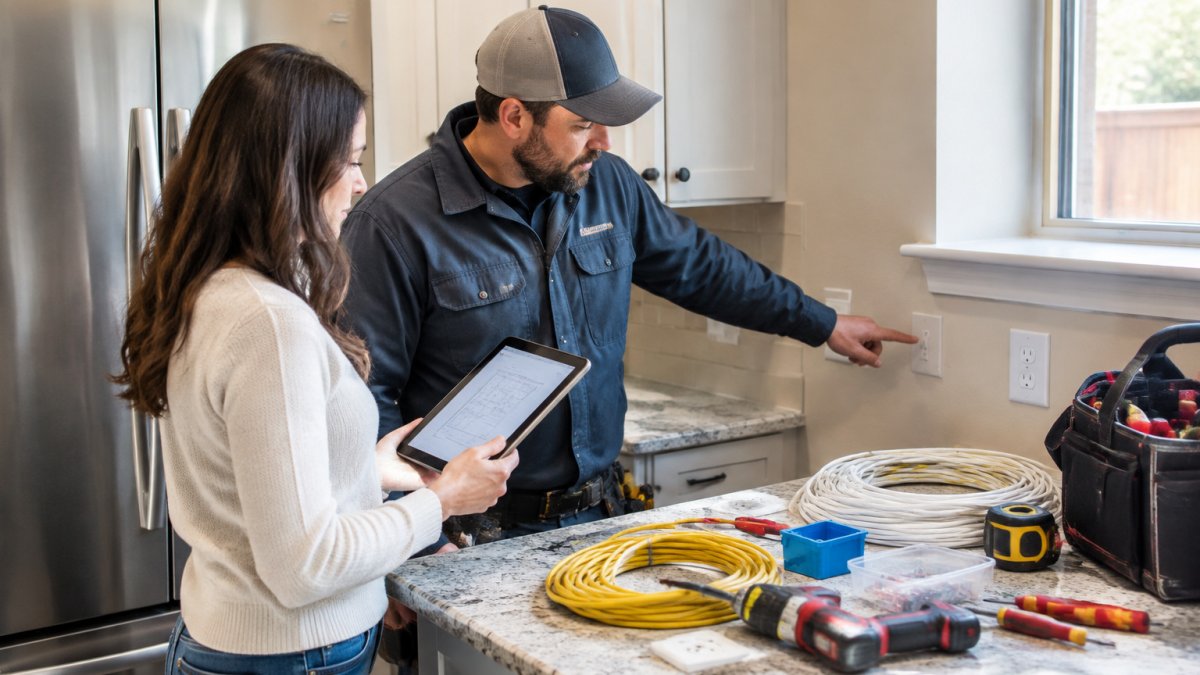
- Describe the goal in electrical terms. Explain what you want done, such as a new 240-volt circuit for an EV charger, a subpanel for a finished basement, or replacement of an aging panel. Name the equipment if you know it.
- Gather basic home details. Note the home's age, square footage, and whether it has a finished basement or attic. These details tell the estimator how much access the job will require.
- Photograph the panel and the work area. Take a clear photo of the panel with the door open showing the breaker labels, a photo of the service entrance and meter, and a photo of the room or wall where the work will happen. Clear photos help estimators spot access issues and panel capacity problems before the visit.
- Note existing problems. Flickering lights, tripping breakers, warm outlets, or a burning smell at the panel should be listed. These change the job from a wiring addition to a diagnostic and repair.
- State your constraints. Mention whether walls can be opened, whether the work must happen on a specific date, and whether you rent or own. Constraints shape both the price and the schedule.
- Request a written, itemized quote. Confirm it covers labor, materials, permits, exclusions, and the quote validity period.
- Compare quotes on the same scope. Two bids are only comparable if they describe the same work, the same inclusions, and the same exclusions.
A common mistake is sending a vague request like "need wiring fixed." That usually produces a rough guess, which often changes once the electrician sees the job.
What the Estimator Does With Your Information
When your request reaches a contractor, the estimator typically checks three things before pricing: the panel's capacity and available breaker spaces, the path the wire will take from the panel to the destination, and whether the existing wiring method and grounding will support the new load. A panel with no open spaces may require a subpanel or a service upgrade, which is a separate line item. A path through a finished ceiling may require drywall work that the electrical quote excludes. Knowing this in advance helps you read the quote as a set of decisions rather than a single number.
How to Compare Two Quotes Line by Line
Put the two quotes side by side and compare four columns: scope, labor basis, materials, and inclusions. If one quote lists a flat fee and the other lists hours, ask the hourly bidder for a not-to-exceed cap. If one includes the permit and the other does not, add the permit fee to the second before comparing totals. If one excludes drywall repair and the other includes it, the difference in price may be entirely finish work rather than electrical work.
Watch out: a quote that is dramatically lower than the others usually differs in scope, permit inclusion, or insurance, not in efficiency. Ask the low bidder to explain the difference in writing before you treat it as the best price.
Questions to Ask an Electrician Before Signing a Quote
Before you sign, ask a few direct questions. The answers reveal how careful the contractor will be.
- Is the quote fixed, or can the price change? Under what conditions?
- Are permit and inspection fees included?
- Who is responsible for drywall, paint, or other finish work after wiring?
- Is the electrician licensed and insured for this type of work?
- What warranty applies to the workmanship, and for how long?
- What is the timeline, and what happens if the schedule slips?
Get clear answers in writing. Vague responses to these questions are often the first sign of change orders later.
Before you sign, these questions reveal how careful the contractor will be and where the quote may change.
| Question | What to look for | Why it matters |
|---|---|---|
| Is the quote fixed, or can the price change? | Stated conditions for any change | Prevents surprise change orders |
| Are permit and inspection fees included? | Clear yes or no in writing | Permits are often left out of low bids |
| Who handles drywall, paint, or finish work? | Named responsibility | Finish work is often excluded |
| Is the electrician licensed and insured? | Proof for this type of work | Protects you if something goes wrong |
| What warranty applies to workmanship? | Duration stated | Defines recourse after the job |
| What is the timeline and what if it slips? | Start and completion window | Sets expectations on schedule |
DIY vs. Professional Wiring: Safety Risks to Weigh
Some homeowners consider doing electrical work themselves to save money. Before deciding, you can check the warning signs of outdated electrical wiring in your home. Light fixture swaps and outlet replacements are within reach for many people, but wiring a new circuit, working inside a panel, or altering service entrance equipment carries real risk.
Professional work also comes with licensing, insurance, and code compliance. If an issue arises after a licensed electrician completes the job under a permit, there is a clear path to resolution. If you are unsure whether your current wiring is safe, start with a professional assessment before deciding whether to do any work yourself.
Booking Your On-Site Assessment with T6 Electrical Contractor
A quote is most accurate when the work is seen in person. T6 Electrical Contractor offers personalized consultations for residential and commercial projects, including smart home automation and EV charging.
To get started, book an on-site assessment with T6 Electrical Contractor, or visit the website for current pricing or a quote.
Frequently Asked Questions
Can you get a free quote from an electrician?
Many licensed electricians offer free estimates for residential wiring work, especially when the job requires an on-site assessment before pricing. Free quotes typically cover the scope you describe, materials, labor and any permit needs. Ask upfront whether the estimate is free, whether a site visit is required, and how long the quote remains valid. Be cautious of quotes given over the phone without seeing the space, since hidden conditions in older homes often change the final cost.
How much does it cost to rewire a 2,000-square-foot house?
Rewiring costs vary widely by home age, layout, wall access, panel condition and local labor rates, so a single national figure is unreliable. For a 2,000-square-foot house, get at least two or three written estimates that break out labor, materials, permit fees and inspection costs. Compare the scope line by line rather than the total alone, because a lower bid may exclude work that a higher bid includes.
What should an electrical wiring estimate include?
A complete estimate should list the project scope, the number of circuits or runs affected, materials and brands, labor hours or flat rate, permit and inspection fees, cleanup, and any warranty on workmanship. It should also state how long the quote is valid and what triggers a change order. If an estimate is a single lump sum with no breakdown, ask for itemization before comparing it to other bids.