 how-to
Troubleshooting Tripping Circuit Breakers: A Safety-First Guide
Table of Contents
- Why Circuit Breakers Trip: Understanding the Three Main Causes
- How to Reset a Tripped Circuit Breaker Safely
- Circuit Breaker Overload Symptoms and How to Spot Them
- Circuit Breaker Trips With Nothing Plugged In: Diagnosis Steps
- Testing Appliances and Isolating the Problem
- When to Replace a Circuit Breaker vs. Troubleshoot Further
- When to Call a Licensed Electrician
- Frequently Asked Questions
Last Updated: October 16, 2026
Why Circuit Breakers Trip: Understanding the Three Main Causes
A tripped circuit breaker happens when too much current flows through a circuit, and the breaker shuts off power to protect your home from fire or electrical damage, tripping circuit breakers is a safety mechanism, not a malfunction. We help homeowners diagnose these issues and know when a simple reset will work versus when professional help is needed.
Overloaded Circuits
An overloaded circuit happens when you plug in too many devices at once and draw more power than the circuit can handle, so the breaker flips off automatically. Common culprits include running a space heater, microwave, and coffee maker on the same circuit, or plugging multiple high-power tools into one outlet. Overloads are usually easy to fix: unplug some devices and reset the breaker.
Short Circuits and Ground Faults
A short circuit occurs when a hot wire touches a neutral or ground wire inside an outlet, switch, or appliance, creating a sudden surge that causes tripping circuit breakers to stop the current instantly. A ground fault is similar but involves current flowing to the ground instead of the normal circuit path, and is especially dangerous in wet areas like bathrooms and kitchens.
Arc Faults
An arc fault happens when electricity jumps across a gap in damaged wiring, creating a small spark or arc inside walls, behind appliances, or in loose connections. Arc faults are harder to spot than short circuits but just as dangerous, and often occur in older homes, areas where wires have been damaged by rodents or construction, outlets with loose connections, and appliances with worn cords.
How to Reset a Tripped Circuit Breaker Safely
Resetting a tripped breaker is straightforward, but safety comes first. A tripped breaker is doing its job by shutting off power to prevent a fire or electrical hazard.
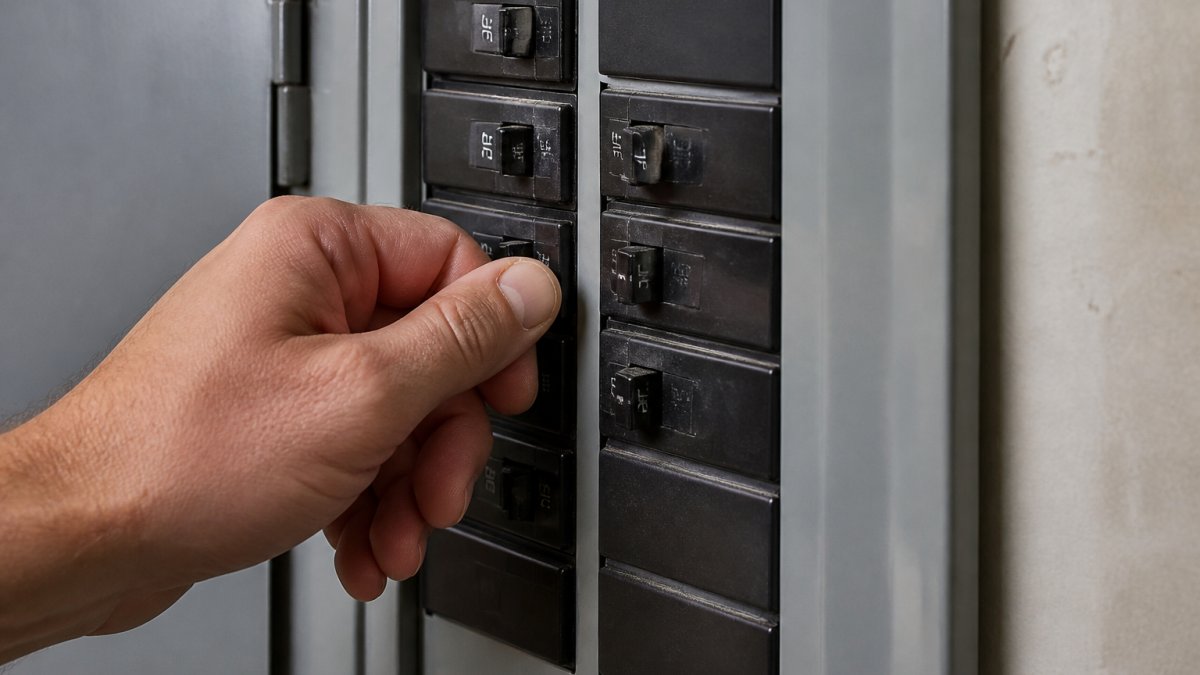
Here's how to reset your breaker safely:
-
Locate your breaker box. It's usually in the basement, garage, utility room, or outside on the wall. Open the metal door carefully.
-
Find the tripped breaker. Look for a switch in the middle position or fully OFF; other switches will be ON.
-
Unplug devices on that circuit. This reduces the load and helps prevent an immediate re-trip.
-
Flip the breaker fully OFF, then back ON. Push it all the way to OFF first, then back to ON. You should hear or feel a click.
-
Test the circuit. Plug in one device at a time and see if the breaker holds. If it trips again right away, stop and call an electrician.
Safety tip: Never touch the main breaker or anything inside the breaker box unless you're trained. The main panel carries dangerous voltage even when individual breakers are off.
Circuit Breaker Overload Symptoms and How to Spot Them
Overload symptoms are the easiest to recognize: your breaker trips when you use multiple high-power appliances at once, then stays on once you unplug something. Common signs include tripping when you use a hair dryer and microwave together, happening in the same room every time, resetting easily, and occurring during peak usage times. If you see these patterns, you have an overloaded circuit, not a dangerous fault.
Circuit Breaker Trips With Nothing Plugged In: Diagnosis Steps
When your breaker trips with nothing plugged in, you have a real electrical problem, usually a short circuit, ground fault, or arc fault in the wiring or a hardwired appliance. Follow these steps to narrow it down:
-
Do not keep resetting the breaker. Every reset risks damage to wiring or equipment. If it trips immediately, stop.
-
Check for obvious damage. Look at outlets, switches, and visible wiring on that circuit for scorch marks, melting, or a burning smell. If yes, call an electrician immediately.
-
Turn off all switches on that circuit. Flip each light switch to OFF and unplug everything.
-
Try resetting the breaker once. If it stays on with everything off, the problem is in the wiring or a hardwired device (like a ceiling light or exhaust fan).
-
Turn switches back on one at a time. Flip one on, wait 30 seconds, then try the next. If the breaker trips on a specific switch, that circuit has the problem.
-
Call a licensed electrician. You've isolated the issue to a specific circuit or device; professional diagnosis is needed.
Testing Appliances and Isolating the Problem
If your breaker trips when you plug in a specific appliance, that device is likely faulty. Test appliances one at a time to find the culprit:
-
Reset the breaker and unplug everything on that circuit.
-
Plug in one appliance at a time, starting with the device you suspect.
-
Wait a few minutes. Some faults develop slowly.
-
If the breaker trips, that's your faulty appliance. Unplug it, do not use it, and have it repaired or replaced.
-
If it doesn't trip, unplug it and test the next device. Work through each appliance methodically.
-
Check for GFCI outlets. In bathrooms and kitchens, look for outlets with TEST and RESET buttons, GFCI outlets (ground fault circuit interrupter). If one trips, it's protecting you from a ground fault in that area. Reset it and test appliances near it.
When to Replace a Circuit Breaker vs. Troubleshoot Further
Most tripping breakers do not need replacement, the breaker is doing its job. The real question is whether the breaker itself is failing or correctly responding to a fault elsewhere. To answer that, read two things: the type of breaker and the timing of the trip.
Know Your Breaker Types and What Their Indicators Mean
Modern panels can contain several breaker types, each tripping for different reasons.
- Standard breaker: Protects against overloads and short circuits. Single switch, no test button. If it trips, the cause is almost always excess current or a fault on the circuit.
- GFCI breaker: Protects against ground faults, especially in bathrooms, kitchens, garages, and outdoors. Has a TEST button and usually a RESET button. If it trips, current is leaking to ground, often through moisture or a damaged appliance.
- AFCI breaker: Protects against arc faults in damaged wiring or loose connections. Has a TEST button and often an indicator light or trip flag.
Many panels also have a trip indicator, a small window, flag, or light showing the breaker tripped rather than being switched off manually. Check it before resetting; it confirms the breaker acted on a fault.
Read the Trip Timing to Narrow the Cause
The timing of the trip is one of the most useful diagnostic clues. Use this chart to narrow the cause before you call anyone.
| Trip timing | What it usually means | Safe homeowner action |
|---|---|---|
| Trips immediately when reset, nothing plugged in | Short circuit, ground fault, or arc fault in the wiring or a hardwired device | Stop resetting. Call a licensed electrician. |
| Trips immediately when a specific appliance starts | Fault inside that appliance or its cord | Unplug the appliance and do not use it. Test other devices on the circuit. |
| Trips after a few minutes of use | Overload or a device drawing more current as it heats up | Reduce the load on the circuit. If it still trips with one device, test that device. |
| Trips only when multiple high-demand appliances run together | Overload, the circuit is at or above its rating | Spread devices across circuits or have an electrician add a dedicated circuit. |
| Trips randomly, no clear pattern | Loose connection, intermittent fault, or aging breaker | Have an electrician inspect the circuit and breaker. |
| Trips only in wet or humid conditions | Ground fault, often at an outdoor outlet or a GFCI-protected circuit | Check for moisture, reset the GFCI, and call an electrician if it repeats. |
Understand Breaker Ratings and Circuit Capacity
Every breaker has an amperage rating printed on its handle or face, commonly 15A, 20A, 30A, 40A, or 50A, the maximum current the circuit is designed to carry continuously. A 15A circuit at 120V supports roughly 1,440 watts, and a 20A circuit roughly 1,920 watts. High-demand appliances such as space heaters, microwaves, hair dryers, and window air conditioners can each draw 1,000 to 1,500 watts or more, so two on the same 15A circuit can push it over the limit.
Signs the Breaker Itself May Be Failing
A breaker can wear out after years of service or repeated trips. Consider replacement evaluation if it trips repeatedly with nothing plugged in and no visible damage, trips the moment you reset it with no devices on the circuit, feels hot when lightly loaded, has a loose or mushy switch that won't stay ON, is original to a panel several decades old, or fails its TEST button check.
Even when these signs point to the breaker, a licensed electrician should confirm the diagnosis before replacement, since working inside the panel is dangerous without proper training and equipment.
When to Troubleshoot Further Instead
Keep troubleshooting on your own only when the pattern is clearly load-related: the breaker trips only when you use specific appliances together (reduce load or add a circuit), it trips in a bathroom or kitchen and a GFCI outlet or breaker resets it (check for moisture and test the GFCI), or it resets easily and stays on with a lighter load (likely an overload, not a breaker problem).
If you have tested appliances, checked for damage, and the breaker still trips unexpectedly, stop and call a licensed electrician. The next step is diagnostic testing inside the panel and circuit, which is not a homeowner task.
When to Call a Licensed Electrician
Most guides list scary symptoms and tell you to call someone, but not where the line is between a safe homeowner check and a stop-now situation. Use this decision tree.
Step 1: Stop Immediately If Any of These Are Present
Do not troubleshoot or reset the breaker. Leave the area and call a licensed electrician right away if you notice any of the following:
- Burning smell near an outlet, switch, appliance, or the breaker panel
- Visible sparks from an outlet, switch, cord, or panel
- Buzzing, crackling, or popping sounds from an outlet, switch, or wall
These are stop conditions indicating an active fault that can escalate to a fire. No reset, no testing, no waiting.
Step 2: Call an Electrician Soon If These Apply
These situations are not immediate emergencies, but they are beyond safe homeowner troubleshooting:
- The breaker trips immediately when you reset it with nothing plugged in
- A GFCI or AFCI breaker trips repeatedly in the same location
- Breakers trip frequently across multiple circuits in the home
Step 3: Safe Homeowner Checks You Can Do First
Before calling, you can safely do these checks without opening the panel or touching wiring:
- Unplug devices on the tripped circuit and reset the breaker once
- Test and reset GFCI outlets in bathrooms, kitchens, garages, and outdoors
- Test GFCI and AFCI breakers using their TEST buttons
Write down what you find. That information helps the electrician diagnose faster and can reduce the time spent on-site.
What an Electrician Will Inspect and Likely Repair
When a licensed electrician arrives, the diagnostic process follows a predictable path:
- Panel inspection: Check breaker ratings, wire sizes, connections, and for signs of heat or corrosion.
- Circuit testing: Measure current draw, check for ground faults, and test for arc signatures on AFCI circuits.
- Device inspection: Open suspect outlets and switches to look for loose connections, backstabbed wiring, or damaged insulation.
- Appliance isolation: Confirm whether a specific appliance is the cause by testing it on a known-good circuit.
- Repair or replacement: Depending on findings, the fix may be as simple as tightening a connection, replacing a worn outlet, replacing a failing breaker, or adding a dedicated circuit for a high-demand appliance.
Most repeated-trip calls resolve to a loose connection at an outlet or a worn GFCI device rather than a failed breaker. Replacing the breaker without finding the real cause just moves the problem.
What Not to Do
- Do not work inside the breaker panel without training and proper equipment
- Do not bypass a breaker or install a higher-amperage breaker to stop trips
- Do not ignore repeated trips hoping the problem resolves on its own
These actions create fire hazards and can void insurance coverage if they contribute to a loss.
T6 Electrical Contractor specializes in diagnosing and fixing breaker problems safely. We inspect wiring, test circuits, and replace faulty breakers or outlets without putting your home at risk.
Frequently Asked Questions
Why does my circuit breaker keep tripping even though there's nothing plugged in?
A tripped breaker with no load usually signals a ground fault, short circuit, or faulty breaker itself. Ground faults occur when electricity escapes its intended path through damaged insulation or moisture. Short circuits happen when hot and neutral wires touch. If the breaker trips immediately after reset with nothing connected, the fault is in the wiring or the breaker is failing. This requires a licensed electrician to inspect the affected circuit and test for wiring problems or breaker replacement.
What are the main circuit breaker overload symptoms I should watch for?
Overload symptoms include a breaker that trips when you plug in or turn on multiple devices. These signs mean the circuit is carrying more current than its rating allows. Reduce the electrical load by unplugging non-essential devices or redistributing appliances across different circuits. Repeated overloads indicate insufficient circuit capacity and may require a new dedicated circuit from a professional electrician.
How do I safely reset a tripped circuit breaker?
First, identify which breaker has tripped by looking for a switch in the middle or OFF position in your breaker box. Before resetting, unplug all devices on that circuit to remove the load. Flip the breaker fully to OFF, then back to ON. If it trips immediately, do not reset it again, this indicates a serious fault. If it holds, plug devices back in one at a time to find the problem appliance. If the breaker trips repeatedly even under normal load, stop using that circuit and contact a licensed electrician.
When should I replace a circuit breaker instead of troubleshooting?
Replace a breaker if it trips repeatedly with no faulty appliance or overload present. Aging breakers lose their ability to respond correctly and become fire hazards. If testing appliances and reducing load don't solve the problem, the breaker itself may be failing. A licensed electrician can replace it if needed, this is not a DIY repair.