 how-to
Commercial Building Safety Inspection Cost: 2026 Guide
Table of Contents
- What Affects Commercial Building Safety Inspection Cost
- Commercial Building Inspection Cost Per Square Foot Breakdown
- Life-Safety Systems and Code Compliance Impact on Pricing
- Commercial Building Inspection Checklist and Scope Boundaries
- How to Get an Accurate Commercial Building Inspection Quote
- Commercial Electrical Inspection Cost and Specialized Systems
- Regional Pricing Differences and Ongoing Compliance Costs
- Frequently Asked Questions
Last Updated: October 14, 2026
What Affects Commercial Building Safety Inspection Cost
No two inspections are identical. The price depends on interconnected factors inspectors evaluate before quoting. Property managers navigate these variables to get accurate estimates.
The biggest mistake property managers make is assuming all inspections cost the same. A 5,000-square-foot office costs far less than a 50,000-square-foot manufacturing facility, but square footage alone doesn't determine price. Building type, age, condition, and scope all play critical roles.
Property Size and Square Footage
Larger properties require more time: an inspector must walk every floor, evaluate every system, and document findings across a bigger footprint.
Most inspectors use per-square-foot pricing as a baseline. A small retail space under 10,000 square feet typically costs less per square foot than a massive warehouse because compact layouts are quicker to inspect.
When you request a quote, always provide exact square footage, this helps inspectors give an accurate initial estimate.
Building Type and Use
A medical office, manufacturing facility, retail store, and data center each require different inspection approaches, systems, code requirements, and risk profiles.
Hospitals demand the most rigorous inspections because patient safety depends on reliable electrical systems and backup power.
The building's primary use impacts how long an inspection takes and what specialized knowledge the inspector needs, so tell the inspector exactly what happens in the building.
Building Age and Condition
Older buildings present more unknowns. A 50-year-old structure requires extra time to identify outdated wiring, assess deterioration, and check for code violations that were legal at construction but no longer meet current standards.
Newer, recently renovated buildings cost less to inspect because systems are better documented.
When scheduling, mention the building's age and any recent updates so the inspector can prepare.
Inspection Scope and Systems Included
This is where commercial building safety inspection cost varies most dramatically.
Scope boundaries matter: some inspections cover only electrical systems, while others include HVAC, plumbing, structural assessment, fire protection, and accessibility compliance. More systems means higher cost and longer inspections.
Before requesting a quote, clarify what needs inspecting. Do you need only electrical safety evaluation, or also life-safety systems, fire suppression, and emergency lighting?
Commercial Building Inspection Cost Per Square Foot Breakdown
Per-square-foot pricing provides a useful budgeting framework, though actual costs vary with complexity.
Most inspections fall into these ranges by property size. Treat them as planning bands, not quotes, a firm number requires a site visit.
- Small properties (under 10,000 sq ft): roughly $0.10 to $0.25 per square foot, with a typical minimum fee of $300 to $600 because fixed overhead (travel, report writing, scheduling) does not shrink with the building
- Mid-sized properties (10,000-50,000 sq ft): roughly $0.06 to $0.15 per square foot, where efficiency improves and the inspector can batch system checks
- Large properties (50,000+ sq ft): roughly $0.03 to $0.10 per square foot, as fixed costs spread across more area, but complex large buildings can exceed this band
A 5,000-square-foot retail space lands around $500 to $1,250; a 25,000-square-foot office near $1,500 to $3,750; a 100,000-square-foot warehouse between $3,000 and $10,000. These are starting points; the factors below move them up or down.
Itemized Cost Breakdown by Inspection System
Broad ranges hide where the money goes. Most inspectors build quotes by adding line items per system in scope. A transparent breakdown looks roughly like this:
- Structural and foundation assessment: 15-25% of the total, visual review of load-bearing elements, settlement signs, and roof structure
- Electrical systems: 15-25%, service entrance, panels, branch circuits, grounding, and load capacity
- Plumbing and drainage: 10-15%, supply lines, fixtures, drains, and visible leaks
- HVAC and mechanical: 15-20%, equipment condition, ductwork, controls, and ventilation
- Fire and life-safety systems: 15-25%, alarms, suppression, emergency lighting, egress, and signage
A lump-sum quote is hard to compare. Ask for the line-item split. If one inspector quotes $2,000 for a 20,000-square-foot building and another $3,500, the difference is usually scope: the lower bid may exclude fire and life-safety systems or a written report with photographs.
What Moves the Per-Square-Foot Rate
- Building age: pre-1980 structures often add 10-20% because outdated wiring, asbestos-era materials, and undocumented renovations take longer to assess
- Occupancy type: healthcare, assembly, and childcare uses add 15-30% due to stricter life-safety and accessibility requirements
- System complexity: multiple HVAC zones, three-phase power, backup generators, and fire pumps each add inspection time
- Documentation quality: as-built drawings and maintenance logs can cut inspection time; missing records force the inspector to trace systems from scratch
- Access constraints: locked tenant spaces, occupied units, and limited roof access extend the visit
When comparing quotes, ask whether the per-square-foot estimate includes all systems or only electrical. This prevents sticker shock on the final invoice.
Commercial building inspection standards and scope guidance
Life-Safety Systems and Code Compliance Impact on Pricing
Life-safety systems are non-negotiable in commercial buildings. Emergency lighting, fire suppression, backup power, accessibility features, and evacuation routes determine whether occupants can safely exit during an emergency.
Thorough life-safety inspection takes time and specialized knowledge: verifying emergency generators work, backup lighting functions, suppression systems are charged and accessible, and evacuation routes are marked and unobstructed.
Life-safety and code compliance evaluation is built into your quote. Properties with known compliance issues or decades-old systems typically require longer inspection time and higher fees.
Commercial Building Inspection Checklist and Scope Boundaries
Understanding what an inspection includes, and excludes, prevents cost misunderstandings. The scope boundary is where most bid disputes start: two quotes for the same building can differ by thousands because one includes systems the other excludes.
A typical commercial building inspection checklist covers:
- Electrical panels and circuit breakers
- Grounding and bonding systems
- Outlet and switch functionality
- Lighting systems and emergency lighting
- HVAC equipment and ductwork
What a Standard Inspection Does Not Cover
Most inspections do NOT include the following. Each exclusion is a potential add-on cost:
- Invasive testing that requires cutting into walls or ceilings, adds $500 to $2,500 or more depending on how many locations are opened
- Detailed engineering analysis or design recommendations, a licensed engineer's stamped report is a separate engagement, often $1,500 to $5,000
- Specialized environmental testing (mold, asbestos, radon), each test typically runs $300 to $1,500 per sample or per area
- Pest control evaluation, a licensed pest inspector is a separate vendor
- Tenant improvements or cosmetic issues, outside the safety scope entirely
Knowing these boundaries helps you request additional specialized inspections. If your building has suspected mold, asbestos, or environmental concerns, you'll need separate specialists.
How to Compare Bids Without Getting Burned
The lowest quote is rarely the cheapest outcome. Use a scope-comparison checklist before signing:
- Credentials: does the inspector hold a relevant certification (for example, a licensed professional engineer, a certified building inspector, or a trade-specific license)? Ask for the license number and verify it.
- Insurance: general liability and errors-and-omissions coverage. An uninsured inspector who misses a defect leaves you holding the repair bill.
- Deliverables: written report with photographs, system-by-system findings, and a prioritized repair list, or just a verbal summary? The report is often the most valuable part of the fee.
- Turnaround: how many business days until the report arrives? Rush fees are common and can add 20-50%.
- Exclusions: which systems are explicitly out of scope? Get this in writing.
Ongoing Compliance and Reinspection Costs
An inspection is a snapshot, not permanent clearance. Many jurisdictions require recurring inspections, fire alarms, sprinklers, backflow preventers, elevators, and boilers often carry annual or semi-annual verification. Budget for these separately.
Follow-up costs to plan for:
- Reinspection after corrective work: often 50-75% of the original fee, since the inspector only revisits the corrected items
- Code violation remediation verification: may require a licensed contractor's sign-off plus a re-inspection
- Permit-related inspections: handled by the local authority having jurisdiction, with their own fee schedule
- Documentation updates: if systems are modified, as-built records should be updated to avoid future inspection delays
A building that passes today may need follow-up work for code violations or deferred maintenance. Plan for reinspection costs if major systems are updated or code requirements change.
How to Get an Accurate Commercial Building Inspection Quote
Accurate quotes require specific information upfront. Vague requests lead to vague estimates. Here's what to include:
Property Details:
- Exact square footage
- Number of floors
- Year built and last major renovation
- Current occupancy and building use
System Information:
- Types of HVAC systems
- Electrical service size and panel condition
- Backup generator presence and age
- Fire suppression system type
- Known issues or recent problems
Scope Clarification:
- Do you need electrical inspection only, or all building systems?
- Are life-safety systems included?
- Do you need code compliance assessment?
- Is this a pre-purchase inspection, routine maintenance, or compliance audit?
With this information, inspectors can give a realistic estimate. Most schedule a brief site visit before finalizing their quote to assess actual conditions rather than guess from descriptions.
T6 Electrical Contractor offers personalized consultations to help you choose the right electrical scope that fits your specific needs and budget. We'll help identify what needs attention and explain how each component affects the final cost.
Commercial Electrical Inspection Cost and Specialized Systems
Electrical inspection is often the most critical component of a commercial assessment. Faulty wiring, outdated panels, and inadequate grounding create serious safety hazards and fire risks.
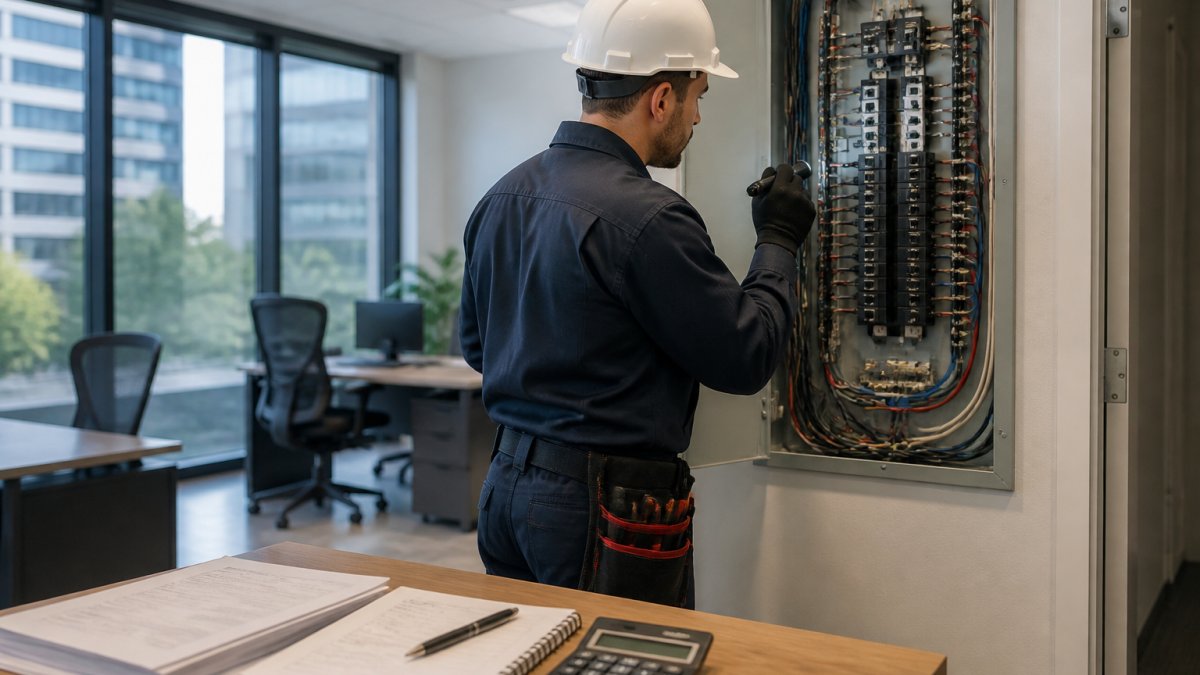
Commercial electrical inspection evaluates:
- Main service entrance and meter
- Distribution panels and breakers
- Branch circuits and wiring
- Grounding and bonding integrity
- Outlet and switch condition
Specialized systems add complexity and cost. If your building has:
- Three-phase power systems
- Complex motor controls
- Industrial machinery connections
- Data center power distribution
- Solar or renewable energy systems
Each specialized system requires additional expertise and time. An inspector qualified for standard commercial electrical work may not be qualified for data center power systems or industrial motor controls, so you may need multiple specialists, increasing total cost.
When budgeting, ask whether the quote includes backup systems, emergency lighting, and specialized equipment. These additions significantly impact the final price.
Regional Pricing Differences and Ongoing Compliance Costs
Inspection costs vary by region based on labor rates, inspector availability, and code requirements.
Location affects pricing and compliance requirements.
Ongoing compliance costs belong in your annual budget.
T6 Electrical Contractor helps property managers understand long-term compliance obligations, explaining what to expect for future maintenance and inspections.
Getting an accurate commercial building safety inspection cost requires understanding the variables that drive pricing: property size, building type, age, condition, and scope.
Frequently Asked Questions
What factors have the biggest impact on commercial building inspection cost?
The primary drivers are property size, building type, age, and inspection scope. Larger properties and those with more complex systems (electrical, HVAC, fire protection, life-safety) cost more to inspect. Older buildings often require deeper evaluation due to code changes. The specific systems included, structural, plumbing, electrical, roof, and specialized assessments, directly affect the final inspection cost. Location and regional market conditions also play a role in pricing.
How is a commercial building inspection quote typically calculated?
Inspectors use several pricing models: per-square-foot rates, fixed fees for specific building types, or hourly rates for complex properties. Many base the quote on building size, then adjust for age, condition, and scope complexity. Life-safety systems and code compliance checks add to the cost. Request itemized quotes that break down fees by system (electrical, structural, HVAC, fire protection) so you understand what's included and can compare bids accurately.
What's included in a typical commercial building inspection checklist?
A standard commercial building inspection checklist covers structural systems, roof condition, electrical systems, plumbing and water systems, HVAC equipment, fire protection systems, accessibility compliance, and environmental hazards. Life-safety systems like emergency exits, lighting, and fire alarms are critical. The scope varies by building type and use. Always confirm what's included in your inspection scope before accepting a quote, some specialized assessments (mold, asbestos, environmental) are separate add-ons.
How often should a commercial building be inspected for safety?
Most commercial properties benefit from annual safety inspections to maintain code compliance and catch issues early. Buildings undergoing property transactions typically need pre-purchase inspections. Older buildings or those with complex systems may warrant more frequent inspections. Local building codes and fire safety regulations may mandate specific inspection intervals. Consult with a qualified inspector about your building's age, use, and condition to determine the right inspection schedule for ongoing compliance.